Airport gate numbering: why the numbers skip around
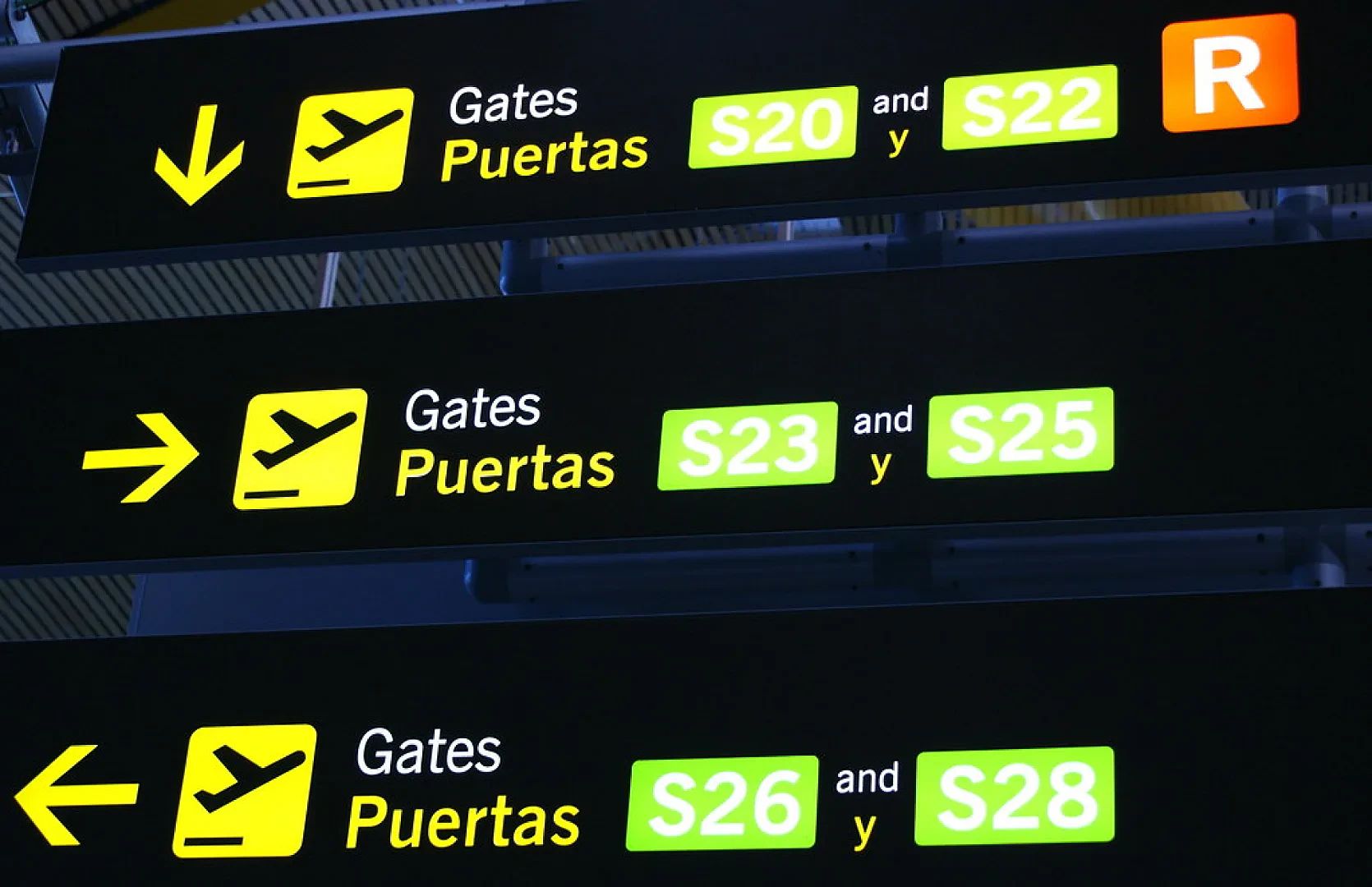
Airports label gates by building, then count positions inside that building, which is why the numbers you see rarely run 1, 2, 3 across a terminal. A gate label works like a street address, and it carries the history of everything that was built, knocked down or widened around it. So a concourse can open at gate 14, and a sequence can run 22, 23, 25 with nothing in between. No federal rule assigns these numbers. Each airport picks its own scheme, and airlines, expansion projects and wide-body aircraft bend that scheme over the decades.
TL;DR
- The letter in your gate label almost always names a concourse or boarding area, and the number counts positions inside that one building.
- Gaps usually come from three things: demolished or rebuilt piers, blocks of numbers held in reserve for expansion, and stands rebuilt to fit a wide-body jet.
- Stuart Vyse reported in the Skeptical Inquirer that Paul Bogard checked all 396 US commercial airports and found 316 whose gate numbers never reach 13 at all. Of the 80 that do, 41 have a Gate 13 and 39 skip it.
- Airports do occasionally renumber everything. San Francisco replaced a single 1-to-90 sequence with per-concourse lettering on 16 October 2019, and Reagan National went alphanumeric on 4 June 2022.
- Gate assignments stay provisional until roughly two to three hours before departure, so check the boards rather than the sign you walked past an hour ago.
Why do airport gate numbers skip numbers?
Three causes account for nearly every gap you will see: a pier that was demolished or rebuilt, a block of numbers held back for future construction, and a stand rebuilt to take a larger aircraft. All three leave the surrounding numbers alone, because renumbering a working concourse means replacing every sign, updating each airline's systems, reprinting the maps and asking thousands of staff to relearn a building they know by heart. Airports would rather live with a hole in the sequence.
Reserved blocks are the least visible cause and the most common. When a terminal is designed with a pier that might be extended west in fifteen years, the planners leave room in the numbering for the gates that extension would add. Then the extension gets delayed or redesigned, and the reserved block sits unused while the gates on either side of it keep their original names.
Demolition leaves the more dramatic holes. New York's JFK is the standard example: passengers move between Terminals 1, 4, 5, 7 and 8, because the buildings that carried the missing numbers were torn down as the airport redeveloped. The Port Authority kept the surviving names rather than shuffle every airline, sign and booking system down a number.
Airport signage in the US does follow published guidance. The FAA's Advisory Circular 150/5360-12F, Airport Signing and Graphics, issued 26 September 2013, covers wayfinding, sign design and graphics across roadways, parking, curbside and the terminal itself. It tells an airport how a gate sign should look and where to hang it, while leaving the choice of name to the airport itself, working with its airlines and, at international facilities, the planning guidance in IATA's Airport Development Reference Manual. For a first-time flyer trying to make sense of all this, our guide to flying for the first time walks through the terminal step by step.
What the letter in front of your gate number means
The letter identifies a concourse or boarding area, and the number counts positions within that building only. Hartsfield-Jackson Atlanta runs seven concourses labeled T and A through F, connected by the underground Plane Train, and each one restarts its own numbering (Hartsfield-Jackson Atlanta International Airport terminal maps). Gate B12 and Gate C12 are both real, both a train ride apart, and neither number tells you anything about the other.

That has a practical consequence on tight connections. A low gate number places you at the start of that concourse, which may be nowhere near security, the entrance or the concourse you just left. At a hub with a train, B2 and C2 can be twelve minutes apart on foot plus a train ride, while B2 and B20 might be a four-minute walk down one hallway. Read the letter first. The number is only useful once you know which building you are standing in.
Some airports label the building and the concourse separately, which is where the confusion usually starts.
Label you might see | What it means | Real example |
|---|---|---|
C23 | Concourse C, position 23 within that concourse | Reagan National, since June 2022 |
B12 | Boarding Area B, position 12 | San Francisco, since October 2019 |
T5 | Concourse T, position 5 (T is a concourse name, not "Terminal 5") | Atlanta |
Terminal 4, Gate 42 | Building number first, then a gate counted within it | New York JFK |
42L and 42R | One large stand split into two positions | Wide-body stands, many airports |
Quick read of any gate label. Work left to right, and stop as soon as you have what you need:
The letter, or the word "Terminal" plus a number, tells you which building to walk to.
The gate number tells you where you land inside that building, and nothing else.
A trailing letter (A, B, L, R) means the stand is shared or split.
A gate number on its own, with no letter anywhere, means the airport has one concourse and you can relax.
Why some gates end in L, R, A or B
A trailing letter usually marks a stand that can be used two ways. Airport planners call these MARS positions, short for Multiple Apron Ramp System: a single stand sized for one wide-body jet that can instead take two narrow-bodies, with the parking positions labeled left and right (Transoft Solutions, Optimizing Apron Capacity with Smart Stand Planning). When a Boeing 787 is on the stand, it is Gate 42 and both jet bridges reach it. When two A320s are on it, they are 42L and 42R.
That flexibility costs the airport a clean sequence. A gate rebuilt to take a wide-body may swallow the footprint of its neighbour, and the neighbour's number quietly disappears from the signs rather than triggering a renumber of the whole pier. Airports also use trailing letters when they squeeze in a new position between two existing ones, which is how you end up boarding at 22A.
If you want to know which aircraft is assigned to your stand, our aircraft profiles cover the types that drive these layouts, and the wide-bodies are the ones that force the L and R splits.
Is there really no Gate 13?
Sometimes, and it is closer to a coin flip than folklore suggests. Paul Bogard examined terminal maps or visited all 396 US commercial airports on the FAA's list, publishing the results in the Skeptical Inquirer on 13 December 2024. Most of those airports are small enough that their gate numbers never reach 13. Among the 80 that do, 41 include a Gate 13 and 39 leave it out.
Bogard also found large airports that are inconsistent with themselves. Chicago O'Hare and Boston Logan each have a Gate 13 in some concourses and skip it in others, which is what you would expect when concourses are designed decades apart by different teams. Some airports omit Gate 13 from the departure signs and still label a Baggage Claim 13.
An airport that drops Gate 13 from its gate signs but keeps Baggage Claim 13 is managing nerves at the one moment they matter, in the minutes before boarding.
When an airport renumbers every gate at once
Occasionally the patched-up scheme gets bad enough that the airport starts over. San Francisco did it on 16 October 2019. Until then SFO ran one sequence from 1 to 90 that increased counter-clockwise around the whole airport, propped up with more than 30 gates carrying A or B suffixes wherever capacity had been added. Opening a 28-gate concourse in the rebuilt Terminal 1 would have broken the sequence past repair, so the airport switched every gate to a boarding-area letter plus a number restarting at 1, from A1 in the International Terminal through G14 in Terminal 3 (Cranky Flier, San Francisco Shuffles Its Gate Numbers, 17 October 2019).
Reagan National made a smaller change with the same logic. On 4 June 2022 DCA moved from plain numbers to alphanumeric gates, so Gate 23 became Gate C23 once its concourse was named C, and the airport renamed Terminal A to Terminal 1 and Terminals B and C to Terminal 2. The Metropolitan Washington Airports Authority tied the change to Project Journey, the construction program that added Concourse E with gates E46 to E59 in 2021, saying that with the new facilities built, "updating the signs airport-wide became the next logical step to help passengers navigate the airport" (MWAA news release, 31 May 2022).
Airports tolerate a messy sequence for decades and renumber only when a construction project forces the issue. That works in your favor: the gaps you see today will almost certainly still be there on your next trip through the same airport, so a layout you learn once stays learned.
Why your boarding pass shows ORD and KORD
Airport codes run on a separate system from gate numbers, and travelers mix the two up constantly. The three-letter code on your bag tag is an IATA location code, governed by IATA Resolution 763 and issued at an airline's request. As of July 2026, IATA's own location codes fact sheet puts the count at roughly 11,300 assigned out of more than 17,000 possible three-letter combinations, with only 40 to 50 new codes issued a year.
The four-letter version, KORD, is an ICAO code, used for flight operations and air traffic control rather than ticketing. Two quirks in the IATA fact sheet explain most of the codes that look wrong. Los Angeles was simply "LA" until the industry moved from two letters to three in 1947, and the airport padded it to LAX. Canadian codes cluster on Y because of pre-war two-letter weather station and radio beacon identifiers, a convention no longer applied automatically. Codes are treated as permanent, and IATA cites Washington Dulles changing from DIA to IAD to avoid confusion with nearby DCA as one of the rare exceptions. If you are decoding a route rather than a code, our route explorer shows what flies from a given airport.
What is an airport gate number?
An airport gate number is the identifier for one aircraft parking position and the boarding lounge attached to it. It is assigned by the airport, printed on your boarding pass by the airline, and it usually combines a concourse or terminal letter with a position number, as in C23 or B12. Gate numbers are operational labels rather than permanent addresses: an airline can be reassigned to a different gate hours or minutes before departure, and airports renumber gates outright when they rebuild.
How to find your gate, step by step
Treat the gate printed on your boarding pass as provisional and the airport's live displays as current. Airlines assign gates from a pool they lease or share with other carriers, so a delayed inbound aircraft can push your flight to a different stand while you are still in the security line. Work through these in order:
Check your terminal before you leave home. Terminal is harder to fix than gate: at JFK, LAX or Heathrow, arriving at the wrong building can cost you 30 minutes and a security queue.
Look up the flight on our flight status checker once the inbound aircraft is airborne, usually two to three hours out. That is when gate assignments firm up.
After security, find a departures board and match on flight number, not destination. Two flights to the same city within an hour is normal at a hub.
Walk to the gate area, then check the sign at the podium against your flight number again.
Re-check the boards after any delay announcement. Delays are what trigger most gate reassignments, so if your flight slips, assume the gate is in play and look at the live departure board for your airport.
If you are connecting, do step 3 for your onward flight before you buy coffee. Knowing the letter tells you whether you have a walk or a train ride, and at that point you know how much time you have. Our guide to what to do when a flight is cancelled covers the next layer of decisions if the delay turns into something worse, and if you are flying at a busy time of year, holiday airport chaos is worth reading before you leave.
Before your next flight
Read the letter, then the number, then the boards. That order holds at any airport, whether the gates run A1 to A30 or jump from 22 to 25. Bookmark our delay data for the airports you fly most and check it while you are still deciding when to leave the house, and see which hubs run worst in our roundup of the best and worst US airports for holiday delays.
Frequently asked questions
Why did my gate change after I arrived at the airport?
Are low gate numbers closer to security?
Why do some airports use terminal numbers and others use concourse letters?
Do international and domestic gates use different numbering?
Related questions
How to know gate number at airport?
Look at any departures board inside the terminal and match on your flight number rather than your destination. Boards refresh within seconds of any change, so they override the gate printed on a boarding pass hours earlier. Airline apps push gate-change notifications if you have alerts switched on, and the gate podium sign is the final confirmation.
Can you check gate number online?
Yes. Gate assignments are published in the same feeds that power airport departure boards, so you can pull them up from home. Our flight status checker shows the current gate for a specific flight, and the live board for an airport shows everything departing. Gates typically firm up two to three hours before departure and stay provisional until then.
What are the gates in an airport?
A gate is an aircraft parking position plus the boarding lounge and jet bridge attached to it. Most are contact stands, where a bridge connects the terminal directly to the aircraft door. Others are remote or hardstand positions, where you board a bus on the ramp and climb stairs. Regional aircraft often use a separate cluster of smaller gates.
How to read airport code?
Three letters is an IATA code, used for tickets, bags and schedules. Four letters is an ICAO code, used by air traffic control and flight operations. IATA assigns its codes at an airline's request under Resolution 763, preferring the first three letters of the place name, which is why unfamiliar codes usually trace back to an old name, a nearby city or a military field.
Sources
International Air Transport Association, IATA Location Codes (fact sheet) (retrieved 25 July 2026)
International Air Transport Association, Airport Development Reference Manual (retrieved 25 July 2026)
Federal Aviation Administration, Advisory Circular 150/5360-12F, Airport Signing and Graphics, 26 September 2013 (retrieved 25 July 2026)
Metropolitan Washington Airports Authority, Reagan National Airport to Enhance Gate and Terminal Signage, 31 May 2022 (retrieved 25 July 2026)
Stuart Vyse, Fear of Flying and the Search for Gate 13, Skeptical Inquirer, 13 December 2024 (retrieved 25 July 2026)
Cranky Flier, San Francisco Shuffles Its Gate Numbers, 17 October 2019 (retrieved 25 July 2026)
Hartsfield-Jackson Atlanta International Airport, Terminal Maps (retrieved 25 July 2026)
Transoft Solutions, Optimizing Apron Capacity with Smart Stand Planning (retrieved 25 July 2026)